
Approaching the grasses, an introduction
‘We will accompany thee and lead thee through a grass-plot…’ John Gerard’s Historie of plants, 1597.
Scotland has wonderful grasses. In this collaboration of poetry and photography we have brought home a harvest to share.
We confidently hope to secure the attention of a large proportion of the observant for the elegant grasses now beginning their varied succession in our rich meadows and pastures. Once begun, we have no doubt of the acquaintance being succeeded by admiration, and ripening into friendship, nor of the cordial satisfaction resulting from the new study. We earnestly entreat our readers to throw themselves without delay into the pursuit of grass-lore, and to begin to collect and to study at once, so that the present season may be fully utilised; for we aim at practical advantage, as well as intellectual, amusement.‘ Margaret Plues, British Grasses, 1867.
Grasses have been overlooked. Omnipresent but unnoticed, they cover around a third of our planet. When people overlook plants nowadays, this is often referred to as ‘plant blindness’. For ourselves, we found that what we had regarded as simply grass revealed itself as a complex and fascinating family of plants. Casting our eyes along the road-verge and shoreline we began to recognise the grasses as distinct from one another. We were starting to see the grasses. As Victorian botanist Margaret Plues promised, our acquaintance with the grasses was succeeded by admiration and ripened into friendship.
‘The grasses are an extraordinarily successful group and their success has been based on three recurring themes: (1) their ability to adapt to the changing environment; (2) their ability to coexist with man and his grazing animals; and (3) their possession of a very distinct life-form that remains faithful to a single architectural idea but which has almost endless, and often very ingenious, variations.’ Tom Cope, Grasses of the British Isles (BSBI, 2009).
Grasses are part of Scotland’s natural and social history. Early forms of grass appeared at the same time as the last dinosaurs. It was the arrival of the grass that allowed human beings to settle and form communities.
Humans and grasses continue to have a close relationship. Grasses need to be used, to regenerate themselves. When fields were scythed, cattle would be let in afterwards to tread the seeds into the soil. This continued the grazing and treading of the domestic animals of the first farmers. Before them, wandering wild bison encouraged the growth of grasses.
A Harvard study on the positive effects of contact with nature during lockdown took place at the Arnold Arboretum in Boston. Among the trees and greensward of the Arboretum, the study noted a decrease in negative thoughts and a reduction of mental fatigue. In our local green spaces, where we can connect with nature on our doorstep, many people find solace and endurance for the hard times.
Grass is good for us. Green is good for us. Green is comforting and refreshing, the spring grass brings hope and warmth. It is a human colour, we respond to green. It has always been the colour of hope and of annual renewal, the sign of awakening life. The grasses can be trodden down and crushed, yet survive.
As the Chickasaw poet, Linda Hogan, observes,
Watching things grow,
wondering how
a cut blade of grass knows
how to turn sharp again at the end
from Dark.Sweet. (Coffee House Press, 2014).
Walking across a patch of grass becomes sustaining, a felt experience that has an impact on the body. When the wind is blowing through grass on the moor or on the shoreline, the whole ground moves and shimmers and there is a great green presence about it. In our experience, looking at grass and listening to words about the grass has made us feel more joyful and more connected to nature. We hope this collection does the same for you.
Valerie & Rebecca
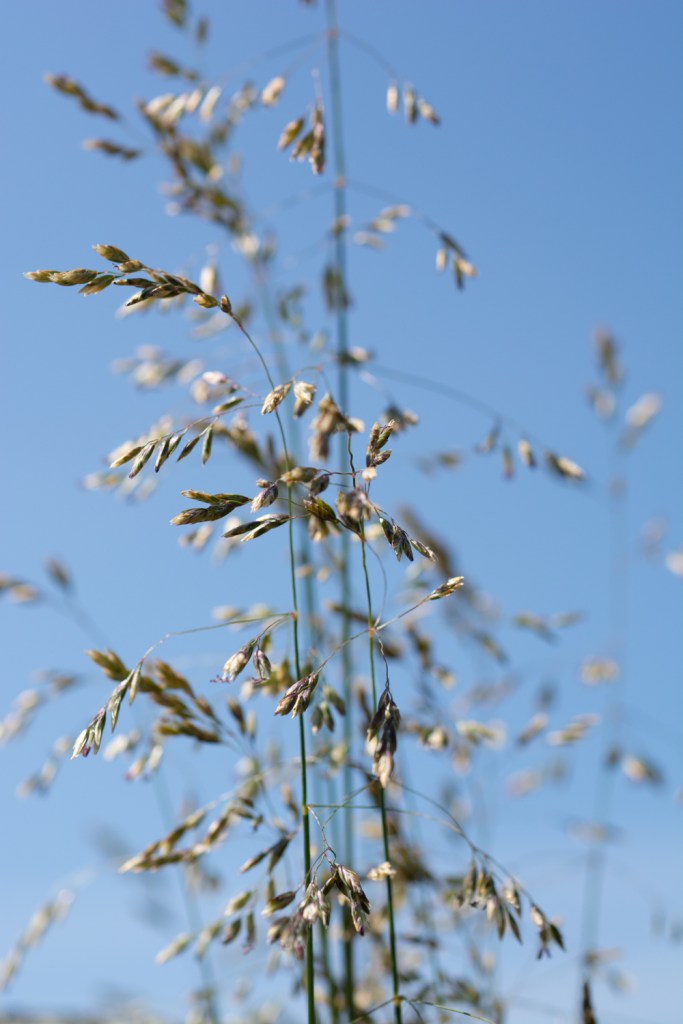
On Time
Now is the time for the flowers of the grasses
to be at their best.
In May and June, some say,
they have their own hours for opening.
Meadow Grass opens between 4 and 5am,
Quaking Grass and Tussock Grass about an hour later,
Meadow Fescue and Cock’s-foot between 6 and 7,
Fox-tail, Cat’s-tail and Sweet Vernal-grass between 7 and 8.
At 11 the Dog-grass opens.
Around noon, the wood Melick, the purple Molinia,
the Mat-grass and the Sea Lymegrass unroll.
About 2pm, the Brome-grass is nodding,
the Wild Oat about 3,
Dog’s Wheat and Twitch Grass at 4.
Wavy hairgrass opens between 5 and 6,
while Fog grass opens twice, downy and pale,
at 6 in the morning and 7 in the evening.
All these grasses like to be on time,
each flower takes twenty minutes to open completely.
Further reading:
The Observer’s Book of Grasses, Sedges & Rushes, Frederick Warne & Co Ltd 1974
Grasses of the British Isles, Tom Cope & Alan Gray, Botanical Society of the British Isles 2009
Grasses, C E Hubbard, Penguin 1954
Grasses, Ferns, Mosses and Lichens of the British Isles, Roger Phillips, Ward Lock Ltd 1980
Identification guide to Ireland’s Grasses, National Biodiversity Data Centre 2016
Flora Celtica, William Milliken & Sam Bridgewater, Birlinn 2006
The Threadbare Coat, Thomas A. Clark, Carcanet, 2020
Braiding Sweetgrass, Robin Wall Kimmerer, Milkweed 2013
National Biodiversity Network NBN Atlas Scotland: Home
Grasses playlist
Diamond Day Vashti Bunyan
Grass baaskaT
Grass Runner Hagia
The Grass Is Greener Ella Washington
Grazing In The Grass Hugh Masekela
Heart Of Grass Silk Rhodes
Mouthful Of Grass Free
Dry Grass And Shadows Alela Diane
The Breeze / My Baby Cries Bill Callahan
Green Grass Cibelle
Listen To The Grass Grow Catrin Finch, Seckou Keita, Gwyneth Glyn
 WHEN THE GRASS DANCES